Liberating Tech for the Elderly: App Prototyping for Social Start-Up
In a world of increasingly pervasive and complex technologies, it is easy to forget the large population of digitally excluded (without access to the internet) or digitally challenged (those who struggle to understand or use modern technology). In the UK in 2018 there were an estimated 5.3 million adults in the UK who did not use the internet. More difficult to measure is the (larger still) population who use the internet or technology but find the user experience challenging or frustrating.
When working in the public sector, this fact is necessarily brought to the front of the mind. Every aspect of digital transformation in government must consider how users will interact and the exclusion implications of digital-first design. Whilst working for Oxfordshire County Council on a project to crowdsource reports of highway defects, we ensured there were alternative channels for reporting problems, such as a phone line or getting help in a library (“assisted digital”).
With these challenges greater than even, I jumped at the chance to support the project of a friend who was creating a start-up with the mission of making smartphones easier to use for the elderly.
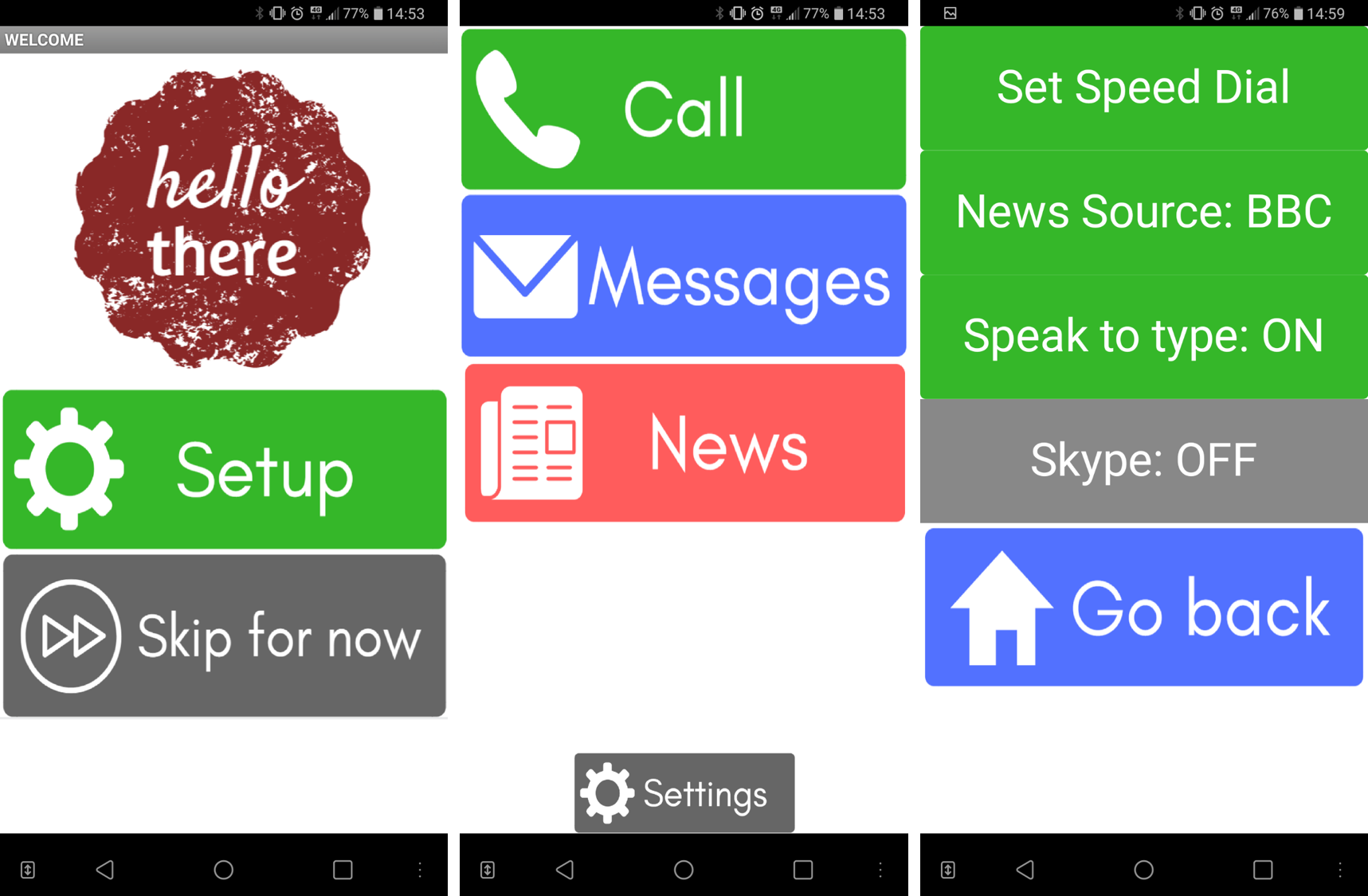
I prototyped an android app to act as a “skin” (launcher) for the home page. It replaced the familiar-for-most screen of small, scattered app icons with a few simple and colourful buttons, complete with large fonts.
From these buttons, the user could complete common smartphone tasks like read the news, check a text message, or make a call (a rarely-used feature for many but can be very useful!).
The app had some neat ease-of-use features like speed dial for frequent contacts, speak-to-type for those who dislike that pesky smartphone keyboard, and integrated skype video calling.
It was a fun project to be involved with and early user tests showed promise.
The next step for the start-up is to establish how it could cover its costs, and then to pitch for funding from potential backers.